Build a shelter and they will come.

The shelters on the Appalachian Trail often host the most unlikely campers. One guy I saw in a shelter, carried a duffel bag full of cotton clothes, a folding chair, and a cell phone from which he made and received many phone calls. Someone else who camped with the same guy said he woke up in the middle of the night screaming her name. That would be freaky.

Another thru-hiker, I talked to, said he was at a shelter, alone, when another person showed up. They talked for a bit, then the guy stepped out of the shelter and started screaming as loud as he could, “Help!…Help!… Help!” Then he turned to the surprised thru-hiker and said with a smile, “No one can hear us here.” The thru-hiker packed up and moved on.

Serious requests only

When my son was three, we lived in a small cottage on the Oregon coast. One day while we where at the post office, we saw a big cardboard cut out of Santa Claus standing next to a mailbox that had written on it, “Santa Claus, North Pole”. We decided to write a letter to Santa. He told me what to say and I wrote it. Then we walked to the post office and put it in the red mailbox that the cardboard Santa was standing next to.

In the letter he asked for a flashlight and a rabbit cup for Christmas. We were gone at Christmas.  When we came back there was a package on the door step. Inside was a flashlight, a rabbit cup and a box of chocolates. The box of chocolates had a note on it that said “For my folks.”

The only thing I can figure out, is the mailbox wasn’t for just any kid to pretend to mail letters to Santa, but for serious requests only.

The coal miners on the Appalachian Trail.

On the Appalachian Trail I met two coal miners in their 50’s who spent their vacations, hiking a section of the trail.  Starting at the begining in Springer, they were working their way through the whole trail.  They were lots of fun; always laughing at what ever was happening. In the short time they were on the trail, they made  lots of friends. Every year, they said, that they would go back for trail days and meet up with all the folks they had met the previous years.

It made me sad to think of them leaving the trail and spending the rest of their summer in the dark mine.

Logistics

I’m pretty much ready to head out to hike the PCT(Pacific Crest Trail), but I won’t be leaving for well over a week.

I’m going to just buy my food along the way. I’m not at all picky and like the challenge and freedom of resupplying at little stores.

The last time I hiked the PCT, I bought all my food before hand and put it in 28 different boxes and paid someone to mail them to me. What a lot of work.

At first, half of the stuff from my mail drops was going into the hiker boxes because I didn’t need that much food in the begining. Then, after my appetite kicked in, half of my food ended up in the hiker boxes because I didn’t like it anymore.

It got pretty common for me to walk into town, find the post office not open, resupply with what ever I could find in town and just forget about the box. Even at Timberline Lodge where people say you can’t resupply from, I didn’t want to wait around for my box, so I just bought some stuff out of the vending machines and hiked on.

At the end of my hike I had a bunch of boxes returned to me and waiting for me at home.

On the Florida trail I had a drift box that was supposed to follow me up the trail. It had all my maps and fuel and stuff but it got lost and I didn’t get it until I got back.

On the AT I just bought along the way and only used Wingfoot’s book for navigation. I didn’t go into one post office the whole trip.

I don’t want to carry all the maps and guide books for the whole PCT so I have made up a drift box that I will keep mailing to myself, 500-700 miles ahead of me. In it I have supplements, pain relievers, socks, ice ax, water treatment, lithium batteries, guide books, maps, data sheets, etc. I really hope the post office doesn’t lose it.

For a bear canister, I can’t decide between the Bear Vault 350(2lbs 1oz) or the Bearikade weekender model(1lb 15 oz). I will decide some time up the trail. Probably order it from Agua Dulce, and have it shipped to Kennedy Meadows. I think most people are carrying the Bear Vault 450(2 lbs 9 oz) but I think it’s too heavy.

For fuel, I’m going to use what canisters I can find in the hiker boxes and stores along the way. I will start the trip without fuel, because you can’t bring it on the plane. I’m not really that into instant mashed potatoes and ramen anyway. Though, hot beverages are one of my favorite things, but, “the path is easy for those without preferences.”

For shoes I plan to hike mostly in Chacos sandals but I’m bringing along a pair of running shoes too. I really don’t want to but I know the PCT is very hard on feet and I want to have the option of giving my feet a change, when they get tired. My feet were my weakest link, the first time I hiked the PCT, and I’m hoping for happy feet this time.

I have said I was bringing the running shoes before, but when it came time to leave, I just couldn’t bear to carry the extra weight and ended up leaving them at home.
Camping on the Florida Trail.

From reading journals of past hikers, where there were stories like the hiker who was woke up by a sheriff who said, “You get out of here and if I see you here again, I’ll take you to jail.â€?, I knew I didn’t want to hike the Florida Trail. Still it was January, I was in Florida, and I was waiting for spring, to start the Appalachian Trail. I decided to hike to the Appalachian Trail from Tampa.

After several nights on the trail which including a night were I walked until 10pm on a paved “rails to trails� pathway and after giving up hope of ever finding any woods to sleep in, literally slept in the ditch, I came to a wildlife preserve. I was relieved to finally be in the woods where I could enjoy the outdoors and feel safe.

Looking for a place to camp that night, I eyed a huge oak tree with branches that arched down to the ground and made a magical protected spot within its branches to camp. It was on the edge of a nice savanna, which also would make a nice spot to camp and where I would get more morning light. I debated for a while over which was the best spot and chose the oak tree. I’m glad I did.

As soon as it got dark, I was woke up by probably 6-8 pickups barreling through the savanna with huge spot lights and men perched on the back with riffles.

I learned that night, when you are on the Florida Trail, you need to make camp in between trees so the pickups that barrel through the woods at night don’t run you over. Even still, the pickups came so close to me one night that I almost jumped up and revealed my position. I talked to a hiker who said a pickup came inches from hitting him one night.

Another thing I learned on the Florida Trail, was to sleep like a rat: always ready to respond. There was usually something going on at night. I wouldn’t see anyone all day and then as soon as it got dark the locals would come out with their large packs of dogs, guns, spotlights and pickups.

I got sick on the Florida trail and would wake up with coughing fits. One night I was coughing away and I see a flashlight moving through the woods towards me. I was feeling around in the dark for my cough drops and thinking “Don’t cough, don’t cough�. After that, I went to a doctor.

The doctor echoed the sentiments of every other Floridian I met– “I wouldn’t be out there without a gun.â€? He warned me about the people that roam the woods at night. He said, “They are doing one of three things, poaching, making moonshine, or checking on their pot plants and you don’t want to meet up with any of them.â€? Among the prescriptions he gave me, was a very expensive bottle of cough syrup. With a good swig of cough syrup, I slept soundly and wasn’t bothered by a thing at night. That worked great until the cough syrup ran out.

Finally, I just excepted that every night would bring some spine wrenching fear episode and I would say to my self, “Just get some sleep, wake up when the nightly incident happens, be scared, and then go back to sleep.� I also started thinking, that maybe if they found me they may not open fire on me as if I were a road sign. Like the person that left a comment said, “They probably weren’t hunting hikers.� That’s a good thing to believe if you are hoping to get some sleep on the Florida Trail.

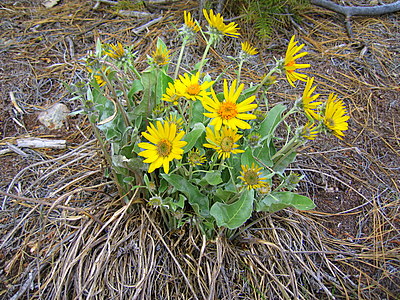
Arrow-leaved Balsamroot–second in the spring parade.

cabin2-142.jpgThis is the Arrow-leaved Balsamroot. It is the second flower to bloom in the spring, after the buttercup, at my cabin.
According to Plants of Southern Interior British Columbia and the Inland Northwest, “All parts of this plant are edible and provided a very important food for the Interior native people. The young leaves can be eaten raw or steamed. The Okanagan smoked the leaves like tobacco. The taproots were roasted or steamed, hung to dry and then soaked overnight. The seeds are like small sunflower seeds and the native peoples dried and pounded them to use as a flour.”

Hiker black holes

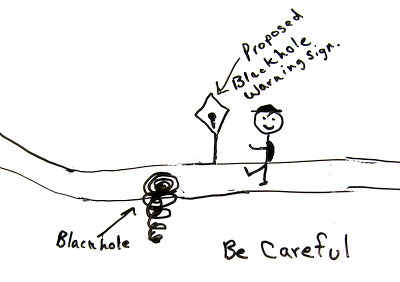
In the Pacific Crest Trail Hiker’s Handbook, Ray Jardine identified the town of Wrightwood as a hiker black hole where hikers stop and never get back out on the trail again. Concerned about this, he advised hikers to not stop there. I didn’t stop there because I was afraid of being sucked in.

When I hiked, I felt there was a black hole at Sonora Pass, where I and several others were almost sucked off the trail.

I have been reading online journals of people out on the trail this year and I would like to identify another possible black hole. Fifteen miles into the trail, at least three hikers have decided that they are too injured to go on. One hiker, hiked fifteen miles, said she almost died of dehydration and flew back home. Another hiker, hiked the first fifteen miles, was attacked by a hummingbird, fell down, hurt his knee and flew home. Another hiker hiked the first fifteen miles and thinks he may have a stress fracture in his foot, so he went home.

I don’t know what my strategy will be for getting through this, but just being aware that it’s there helps.

cabin2-140.jpg

How much does it cost to hike a long trail?

The first long trail I hiked was the PCT(Pacific Crest Trail). I quit my good paying job and planned to return to work the following spring. I looked at the hike as a “trip of a lifetime” and spared no expense. But, like a lot of people that complete a long hike, once I finished the trail, I wasn’t so willing to sell my summers anymore and I still haven’t made it back to work.

Since then I have tried to practice a more sustainable hiking style. If I’m disciplined enough I will keep track of my PCT expenses this trip and see how much I spend.

There is a rule of thumb that everyone throws around that says 1-2 dollars a mile, but, Weathercarrot wrote this article on how he hiked the AT on 1,100 dollars: that’s freedom.

I was reading journals today and found a hiker who is paying for her trip by selling plasma.

Update: I spent about 3,600 dollars. That included buying a couple new pairs of shoes, a new backpack, and new rain gear.  I don’t drink and I tried to get out of town as quickly as I could but sometimes got a room.   I bought lots of fresh food no matter the cost.

A functional way to use a poncho/packcover

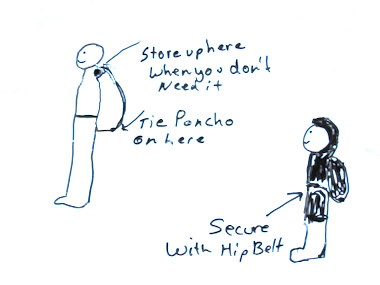
cabin2-122.jpgI used to carry a sil-nylon poncho as a ground cloth, figuring that it would do double duty as rain gear and pack cover. It worked fine as a ground cloth except it was really slippery but as a poncho it would just blow around and was really hard to take on and off by myself.

In the “How to hike the CDT” video, one of the hikers interviewed gave the following instructions for using a poncho:  Tie the back of the poncho to the bottom of your pack, flip up the rest behind your neck.  When you want the poncho on, just reach back and pull it over your head and secure with the waist belt of your pack. When you start getting too hot just un-lash your belt and pull the poncho up over your head and store behind your neck again.

That’s a really functional way to wear a poncho, however I have stopped using a ground cloth so I don’t carry it anymore.

When the skies get dark, climb high.

When I was hiking the PCT (Pacific Crest Trail) and stopping at Mojave for a resupply, an old man told me, “When the skies get dark, climb high”. It was a warning about flash floods in the desert.

Later I heard about a thru-hiker that camped in a dry river bed that year. He said that there were campfire rings in it and it looked well used for camping. That night he was woke up by a strong pressure pushing on him. He fought his way out of his sleeping bag and tarp to swim out of the way of the water. He said that if he had been in a tent he didn’t think he could have gotten out. He lost everything. And hiked into town with nothing but a t-shirt on. He also said that it wasn’t even raining where he was; the water must of come from rain up in the hills.

Seven day weather report for anywhere on the PCT(Pacific Crest Trail)

At http://postholer.com/ you can see the 7 day forecast for anywhere on the PCT.

This message was posted on the pct-l mailing list:

Here at Death Valley, I just met a young hiker, Chris,
who left the trail from Mt. Whitney because of this
storm. He says that there were about 50 other hikers
within a day of him.  Apparently, a lot of them are coming down out of the
Sierras because of this storm.

Man, those hikers are early. Everyone is leaving early this year. I may have the whole trail to myself by the time I get there.

The Great Peruvian Coincidence

Ever since seeing the Peruvian exhibit I have been interested in traveling to Peru.

One summer I was working in Eastern Oregon in the Wallowas . I went to a movie one night and while waiting for the movie to start, I talked with the man sitting next to me. He said he had traveled to Peru and hiked up to Machu Picchu. While camped there that night he had a vision of how to build a clock that would tell you the right time and day to do anything.

After the movie I went back to his house to see his clocks. Some were big like grandfather clocks and others were just drawn on paper. He gave me one drawn on paper. You have to set it everyday but with it you will always know the best time to do anything.

The next morning, I was driving through the woods, looking for a place to call home for awhile and I see a Peruvian shepherd dressed in traditional clothes and shepherding   about a thousand sheep. The Peruvian shepherd flagged me down. He didn’t speak much English but enough to tell me that he wanted some water and that he was from Peru.

Later that day I bought a Sunday paper and started reading the travel section. The article for that week was titled: Peru is safe to visit now.

Note: I don’t know where the clock is. I think it may be at my other cabin. If I find it I will take a picture of it and post it here and then you too can know the best time to do everything, if you can figure it out.

Resupply at the Wilson Creek Shelter.

When I was in a shelter on the AT(Appalachian Trail), waiting for someone to come see about the abandon pack that was left there, we joked about who they would send. We thought for sure they would send search and rescue or a trail runner. But we laughed that they might send two sheriff deputies through the dark woods 2 and one-half miles to the shelter with one of those huge flash lights that work really well for about 40 minutes. And that they would arrive knocking on the bottom of it trying to get it to work better There was probably over 100 lbs of gear left there and we laughed about the the local deputies putting on the pack and walking back out with that huge flashlight about to go out.

About 1 am they arrived, it was two sheriff deputys and sure enough they had one of those big flashlights that was about to go out. One was a big rotund friendly guy and the other was a very skinny guy with slicked back hair and a lot of after shave on. After they found the note that was left with the pack that said the owner had murdered his father and gone to the woods to live, they called in. Even though one 16 year old boy had carried all that gear to the shelter, they told the office that there was 100’s of pounds of gear there and that there was no way that they could pack it all out.

There were probably fifty trail bars. One fell on the ground while they were looking through the pack. The big guy picked it up and said,” I think that one will just have to find it ‘s way into my pocket.”

They decided to just take the knives and the note with them and send someone in the morning to pick up the rest of the gear. They had a little spare flashlight with them to get them back out. Before they left, the big guy pointed to the bag of trail bars and said to us, “If some of these trail bars are gone in the morning, well, I guess that would be all right”

Related post: Bears and murderers