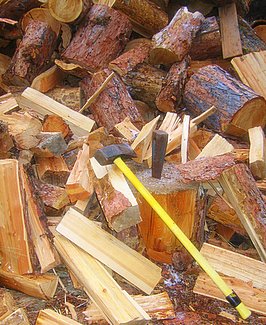
Wood splitting tools

maul and wedgeThese are my wood chopping tools: a twisty wedge and a 8 lb splitting maul.    The splitting maul is made by Ludell and has a  fiberglass handle so if you miss the log and hit the handle it doesn’t break.  I’ve whacked it many times.     You can split logs with one side and whack the wedge with the other.

The twisty wedge is made by Leborgne and will spit almost anything.   It  a good hard wedge that doesn’t mushroom.   It’s very hard to find.   The only ones online, I can find, ship from Europe.   I bought mine from a chainsaw store in Canada.    Here is a different brand shipped from the UK:   BAHCO SPLITTING WEDGE TWISTED STEEL 8 1/2IN Once I found a more cheaply made twisted wedge at Harbor Freight tools but it doesn’t look they sell them anymore.

Most of my wood this year is Tamarack.  Tamarack is so easy to split an ax would work fine,  but alas,  I whacked the wooden handle of my ax, one to many times and now the handle is broken.

Resting and sleeping with elevated feet

elevated1When I rest or sleep on the trail, I try to keep my feet elevated.    I think it helps them to heal.

Some hikers miss having a chair but I  never do; even when there is a picnic table to sit at, I still lie on the ground with my feet on my pack, because having my feet hanging down below me doesn’t feel like a rest.

sleeping on a slopeAt night I  put my pack under my feet or even better— find a slopped place to sleep and point my feet up hill.

feet elevated against a tree.

Cheap cabin eats: Caramelized Onion soup.

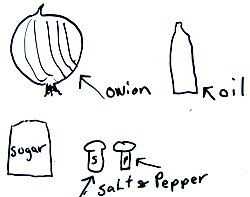
Onion soup ingredientsI used to make this soup all the time at my BC cabin.   Maybe it tasted good because there wasn’t a lot of other stuff to eat but I loved it.   Once some kayakers floated by and I invited them in for a lunch of this soup.    What’s great about it, is all you need is some onions, a little sugar, oil, salt and pepper.

Put  4 tbs. oil in pot.  Add 4 thinly sliced large onions and wilt over medium-low heat, covered for 20 minutes.

Sprinkle 1/4 cup of sugar over onions(I used brown sugar because it’s what I had), toss, and cook, uncovered, until caramelized, 10 minutes.  Sprinkle with salt and pepper.

Add 3 cups of water and simmer, uncovered over medium heat for 15 minutes.    Then add 3 more cups of water and cook for another 40 minutes till it is rich in taste.

Sure it probably would be better if you had beef stock instead of water,  and butter instead of oil, and some port to add flavor.    And yeah some french bread and melted Gruyere, baked on top would probably be nice.   But I never have any of that stuff so this is the way I make it.

When things look bleak…. start singing (loudly and with much enthusiasm)

In the movie Cannibal! The Musical,   a bunch of  guys are lost in the snow without food and they are wondering what they are going to do.  When one of them gleefully shouts, “I know!”  And starts singing the “Let’s build a snowman” song.   One of the other guys finally shoots him and  eats him (illustrating why it’s best to hike alone.)  But the singer had the right idea, because it’s important to keep your attitude up when things look bleak.

Once I was hiking on a reroute in the North Cascades.   It was rainy and cold  and all I had for shoes were sandals.  It was almost dark but I had to keep hiking because I was on a ridge and  there was nowhere to put up my tent.    I also had miscalculated the miles and was about out of food.   Finally I found a place to camp.

The next morning I woke up to snow.   It would snow and then I would drop down in elevation and it would rain and then I would go back up and more snow.   The trail was so muddy and steep in one place I kept slipping and sliding down the hill; I was covered in mud.   I only had about 400 calories to go the next 30-40 miles.   My feet were cold.  The reroute wasn’t well marked and I began to have the sinking feeling that I had missed a turn.   I never stopped singing and smiling that day; if I had known how to tap dance I would have done that too because a bad attitude + a bad situation can quickly send life into a tailspin.

I was belting out show tunes as happily and enthusiastically as I could when I met another hiker.   He looked at me covered in mud,  in my trash bag skirt, my sandals, and my chrome umbrella and  scowled, “What’s with the umbrella!?”

10 before 10 rule

On the trail, If  I can get 10 miles in before 10am I know I  will be set up for a good mileage day.    It is something I  strive for.

Now that I’m off the trail, I have a list of things I’m supposed to do everyday,  I use the 10 before 10 rule there to; I try to get 10 of them completed before 10am and then I know I’m set up for a good day.

The hermitage in my parent’s basement.

It was a daylight basement; it had a whole apartment in it—kitchen, living room with a fireplace, bathroom, bedroom, everything.     I had a brother that lived there for awhile but no one ever went down there but him.   It was a mystery space.    I used to throw rocks  in the open window that was near to the ground and make wishes.   Until one time he was sitting at his desk and the rock hit him.

Once,  when I was around seven or eight,  after he had moved out, I went there to hide for awhile.   While hiding,  I hatched the idea of living in the basement.   I could come up and get food while everyone left for the day.  It would be like running away without all the logistics.    While sitting there the idea grew more and more exciting.  Why hadn’t I thought of this before.

Then, when I was grown, I would emerge from the basement, very polished and possibly even carrying a briefcase,   I would walk pass  my  family, all hunched over their oatmeal,  and I would say coolly, “Hello”  They would all turn and look at me surprised and say “Why, where have you been?”  And I would respond calmly, “I’ve been in the basement.”   Then I would say, “Goodbye,” walk out the door, and drive away.

My plan was foiled after they soon found me hiding in a kitchen cabinet but it was a good idea.

Zero days

A zero day is a day when no miles are hiked.   Most long distance  hikers take them and even think they are necessary, probably because so many hikers tell them they are necessary.      Though  getting a hot bath, ordering a pizza  and laying in bed eating it while watching old movies is wonderful and when it is cold and wet outside can feel like the best thing in the world, I’m not sure it does anything to help my performance and may even hurt it.

What I have found more rejuvenating  than taking a zero day in town is to hike fewer miles on the trail for a few days.    Sleep in, take long breaks hanging out on the crest and eat more food.  I discovered this when after my son would join me for a week of doing 15 mile days I would feel completely rejuvenated in a way that 3 days in a motel room never did it for me.

Zero days break my grove and suck up all my time and money.   I think it’s best to keep moving no mater how slowly.

I hiked with a guy called  “Just Dave” for awhile and I said, “You know, I think zero days hurt performance.”   He said he thought so too. He only took one zero day for the Appalachian Trail and he said it was the worst mistake he made.  I don’t think he took any for the Pacific Crest Trail.    The best hikers don’t take zeros.

Perpetual Camping

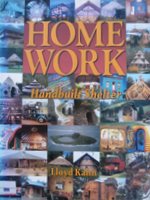
Home workI have an inspiring, fun to look at book called Home work—Handbuilt shelter. It has lots of pictures and diagrams of  little, beautiful, and cheap homemade homes.

One of the articles in it, I thought might be of particular interest to some readers, is called “Perpetual Camping.”    It’s about a  newsletter called  Dwelling Portably. Dwelling Portably is written by  people who find some unused land and dwell there for awhile or otherwise dwell portably.  Doers report on what works and doesn’t, ask questions, and offer advice.

The people  who produce it say:

While quite young, Bert and I decided (separately, before we even met) that buying property was foolish.  You can’t really own land;the government owns it and can kick you off any time you do something that any of dozens of government agencies disapprove of .

We also noticed that much land, especially in the west was not used or was used infrequently.  That inspired us to become perpetual campers: living in a place while it was desirable; moving on when conditions changed.

Issues vary: some have much about vehicular dwellings and little about backpacables or wickiups.  Or vice versa.  So, for a broad sampling, order several back issues.

Bert and I have built portable dwellings that are as comfortable as houses.  In some ways they are more convenient,  because they are small and well insulated, our body heat keeps them warm during winters—avoiding the labor, mess, pollution, and hazard of a heating stove.

Dwelling Portably is $1 dollar an issue.  add .50 if sending check or M.O.  for less then 6 dollars. (Their prices encourage you to order many back issues) 1/$1; 6/$5; 13/$10; 30/$20 Dwelling Portably, POB 190-hwk, Philomath, OR 97370

Or order online from Microcosm Publishing (Thanks, Pig Monkey, for the link)


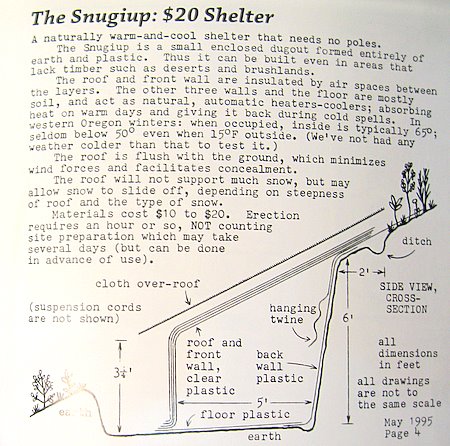
$20 dollar shelter