Home modified 0 degree quilt

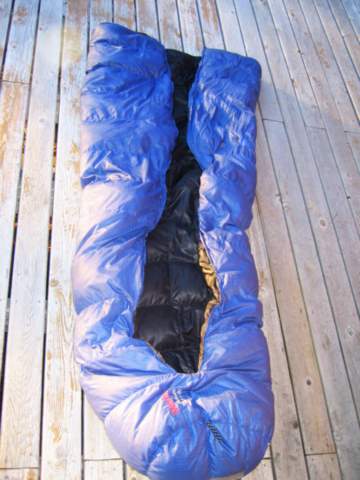
I did it.  I sliced into my new Marmot Helium and turned it in to something worthy of being in the mountains in September.  It weighs 31 oz, is chocked full of down, has not one cold spot, and is luxuriously wide.

First the bag weighed 35 oz.    Then I cut off the hood, the first baffle, the full length zipper, and the zipper baffle.    Then it weighed 24oz.  Next I took all the down from what I had cut off and stuffed it in to the quilt.   Then I took down from my old Marmot Helium  and stuffed even more down into it.   Then it weighed 34 oz.   Then I sewed the seams up and  took it to the laundry and washed it.   Now it weighs 31 oz. *
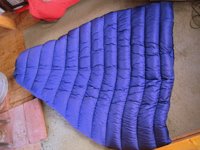
This isn’t the ethereal kind of loft you get from having  just washed your bag, this is the solid kind of loft  you get when your baffles are full of down.    If you slept in a shelter with this bag you’d have to say, “Please excuse my loft.”

For this project you will need: thread, pins, scissors, sewing machine, and a mummy bag.    Also a vacuum cleaner to clean up with.

To make the seams,  I just turned both edges inward, pinned them, and then sewed them up.

Difficulty rating: easy.  Tip: I did this with the down dirty—dirty down is much easier to handle than clean down.
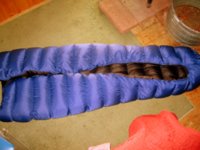
*I brought two bags to the laundry and they both came back  3 oz lighter.   Which seems like it might justify the weight of a silk liner.

Update:  I headed out to the PCT with new quilt in late May.  In the  mountains above Idyllwild, less than 200 miles from the Mexican border, the temperature dropped to well below freezing, the wind was blowing 50-80 mph gusts and it snowed.

I was camping in Z-pack Heximid tarp which let in a lot of the wind.   The bag kept me warm till I rolled over and then I would get cold—I missed the zipper.   I think quilts are better for people how don’t move around much while they sleep.  Maybe if I had put elastic straps to hold it around my pad or ties…..

Now I carry a Z-packs 10 degree bag with a stretchy  liner.   Mostly I sleep with it as a quilt but when it is very cold I zip it.   I also went to using the Gatewood Cape as a tent because it blocks the wind better than the Heximid.
Improving my trashbag rain skirt

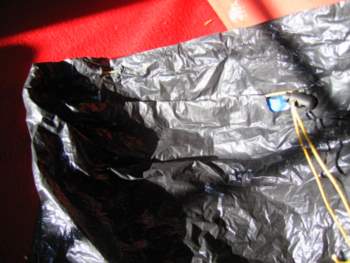
I improved the cinch strap on my trash bag rain skirt by tying a piece of string to a safety pin and pushing it through  the cinch strap pocket.    When I got to the places where the pocket was welded together, I pushed the safety pin through one side of the plastic pocket and back in to the cinch pocket on the other side of the weld.    When I got to the end I  removed the safety pin and put a toggle on the string.

A person could improve a trash bag rain cover the same way.

Building a meditation bench

I’m signed up to attend a 10 day Vipassana meditation retreat at the end of this month.      You sit silently  for 10 days from 4am to 9:30pm watching your breath go in and out.

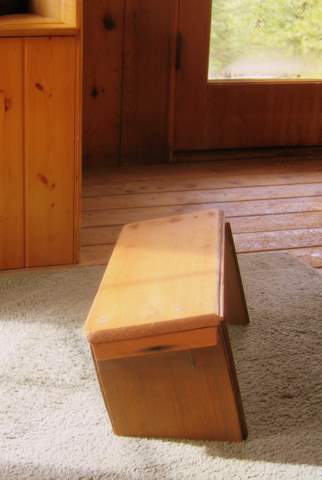
Under what to bring, they list a meditation cushion or a meditation bench.    I found some cedar under my cabin and these instructions on the Internet and in about 10 minutes had built my meditation bench.   It’s  ingenious the way you cut both  legs in one cut.   I didn’t have any hinges so I screwed it together.  Then I put support pieces around the legs.

Converting my mummy bag into a backpacking quilt

After spending a September in the Sierra’s, I want to be in the mountains every September.     Only problem is my sleeping  bag is too cold to be in the mountains in September.   I’ve decided I need a warmer bag, only, the only way to do that and not increase my weight  is to go with a 0 or 5degree  backpacking quilt.    Only problem with that is they are crazy expensive.  For instance the Nunatak Arc Expedition would cost me over 750 dollars once I factored in shipping,  over fill, light weight fabric surcharge and sales tax and it’s not like REI where you can just return it if you don’t like it.    Also I’d have to wait 6-8 week to get my bag.    You’d think not having a hood or a zipper it would be fast and cheap.

Then I had the epiphany to turn my old Marmot Helium into a backpacking quilt.    Searching the Internet I found another hiker who did this.   Purebound turned a 110 dollar– 2Lb 4oz mummy bag into a 400 dollar– 24oz sleep quilt.

I cut off the zipper baffle, the 3/4 zipper, the hood and the first baffle and used the down from them to stuff into the rest of the bag.   Then I slit the opening all the way down leaving a little foot box to stick my feet in and sewed everything back up.     It went from 34 ounces to 28 ounces and I kept all the down.

I like it  but every time I look at it there is another rip in it.  It has about 20 patches and repairs done to it and I ripped a baffle one night when I slept close to a sharp rock.    Also I think it could still use some more down.

So now I’m eyeing my new Marmot Helium and thinking about doing the same thing to it.  Only this time I’m thinking of slicing open up my old Marmot Helium and stuffing a lot more down into the new one.   One thing I learned doing this is there is a whole lot of down in a sleeping bag and it hardly weighs anything.  So if I, say, added 3 or 4 more ounces of down to the new bag and cut away all the stuff I didn’t need, I think I could have a seriously big fluffy quilt for  2 lbs.

If you want a down hood you can save the hood piece and wear it on your head.   I decided that I would rather have the down from the hood on my body because I already carry a fleece balaclava and there is still enough length to throw the bag over my head if it’s really cold.

I may put some straps on it to cinch the bag around me, but right now I’m  thinking that won’t  be necessary as I left the bag fairly wide.

Some people may say that I’m taking 750.00 dollars in mummy bags and trying to turn them into a 750.00 dollar quilt. 🙂

Live at a hot spring off the PCT and get Paid for it.

I found this on the Goldmyer Hotsprings website and thought someone might be interested in it.

Caretakers needed for the Goldmyer Hotsprings.

Northwest Wilderness Programs maintains caretakers at the Goldmyer property all year round to assure our preservation goals for the property. Caretakers live on the property 24/7.  Duties include check-in and management of our visitors and cleaning and maintenance of facilities.  This is a unique opportunity to live and work in one of the last remaining old-growth forested areas in the Pacific Northwest.

We require a 2-person couple or team who have a time-tested and good working relationship.  There is a small off the grid, well-endowed cabin for the caretakers to live in (utilities provided).  The salary is $1500 per month per couple.  Various time periods are available depending on experience and need.  Candidates must have good people and communication skills, have a positive attitude and clean well-kept appearance, have a basic mechanical aptitude, be self motivated and willing to work hard, and able to live in a remote (and at times isolated) mountainous location.

Address inquiries and questions to our office at 206-789-5631 (office hours are Tuesday 1 till 6, and Friday 3 till 8). Please mail resumes and references to: NWWP, 202 N. 85th St. #106, Seattle WA 98103.  Also include a cover letter that explains your past experiences that could relate to living and working in a back-country setting, and if you have visited Goldmyer.

New PCT guidebook

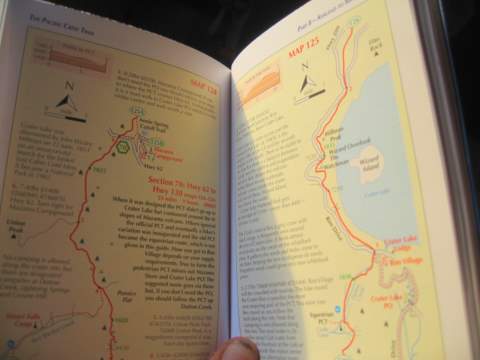
I asked my library to purchase this new PCT hiking guide I wanted to check out:   “The Pacific Crest Trail–from Mexico to Canada on foot” by Brian Johnson aka Ancient Brit.    He’s hiked the PCT 3 times.

It’s a  small book of 350 glossy pages wrapped in a sturdy vinyl cover measuring 7″ x 4 1/2″ , weighing less than a pound, and costing less than 20 bucks.   I think it’s just what was needed.

The first 90 pages covers prep, equipment, planning, what the hiking is like, resupplying, permits, getting to trail, everything.      The next 229 pages are  maps, data, resupply info, trail angel info, water caches, alternate routes, elevation  profiles, town info, birds and plants you are likely to see,  interesting facts about the sites you pass, inspiring quotes, this book has it all.   The final 20 pages are appendixes covering useful websites, books written by PCT hikers, sample hiking schedules and more.

The maps aren’t topo maps and they wouldn’t help much if you got off trail,  but  here’s the thing: the book cost 18.95 16.47 from Amazon and covers the whole trail.