Archive for the ‘Cabin and Car living’ Category

Non-Refrigerated eggs

Thursday, January 4th, 2007

cabin-817.jpg

On the PCT (Pacific Crest Trail), I once used the partial fuel canisters left in the hiker box to cook up some hard-boiled eggs to bring with me on the next section. I carried a bigger pot in those day, I filled it with hard-boiled eggs and then doled them out to myself along the way.

I don’t have a refrigerator at the cabin that I’m now living at but I find that the eggs last at least a month with out refrigeration. When researching refrigerating eggs on the internet, I learned that refrigeration of eggs is a North American thing and that in other countries they are stored on the shelf.

When in Java, I lived with a family that had a little open air store; they had a bowl of eggs sitting on the counter for sale. I was concerned about this bowl of eggs, day after day just sitting there, un-refrigerated in the hot Java weather. They told me that they had soaked them in hot salt water for a while to preserve them. I ate one. It tasted like a perfect hard-boiled egg that hadn’t been cooked too long. They said that if they didn’t sell in 2 weeks that they would bury them for a while and then try to sell them again.

Laen has this to say about it:

For an explanation of why this is, read: Science of Cooking : “Is it okay to leave eggs un-refrigerated?”.

It seems the reasoning is this:
* 1 in 20,000 eggs is infected with salmonella.
* Leaving an egg unfrigerated allows salmonella to multiply.
* Salmonella can be dangerous.

But then, you can also kill salmonella by cooking the egg enough.

So, you’re taking a teeny tiny risk by not refrigerating, but you can counter that risk by cooking the eggs enough to kill the bacteria.

Simple composting toilet

Tuesday, November 28th, 2006

toilet.jpgThis is my composting toilet. I use it, throw the paper in it, and cover with sawdust. When it is full, I dump in under a big pine tree and cover with pine needles. If the pine needles are covered with snow, I cover it with snow. If I have some grey water saved I rinse out the bucket and throw the water on the pile. There isn’t any smell. The toilet usually sits out on my porch but it is very cold now(-6 F -21C) and snowy so I moved it inside.

I’m thinking about building a small addition on to my cabin so it could be kept in it its own room. It a very simple system that I learned from reading the book The Humanure Handbook: A Guide to Composting Human Manure.  Now Free and downloadable at:http://www.jenkinspublishing.com/humanure.html

You don’t have to use sawdust you can use what ever you have, dirt, bark, duff, what ever. For material to cover it outside, the idea is to have something fluffy that allows a lot of air to get to it so that it can heat up, kill any bad stuff, and compost fast. In the book he recommends straw. I use pine needles because that’s what I have. But you could use leaves or weeds or what ever. My bucket is called a Luggable Loo;a five gallon bucket with a toilet seat lid. In the book he builds a nicer looking system. You could just use a 5 gallon bucket with a regular lid.

Washing without soap

Friday, November 17th, 2006

I don’t like using much soap to wash my dishes or me because without copious amounts of hot water, a soapy residue stays on, so, I have been using baking soda when I have a greasy pan to wash and sometimes I use it to wash my hair as well, as I learned to do from this Mother Earth News article. The baking soda acts as the alkali and the grease in the pan or the oil in my hair acts as the fat, put them together and you have soap. It has been working really well until I ran out of baking soda. Lye (the alkali that soap is usually made with) is made from wood ash so I tried washing a greasy pan using hot water and ashes from my wood stove, and it worked great.

Backwoods carpet cleaning

Friday, November 17th, 2006

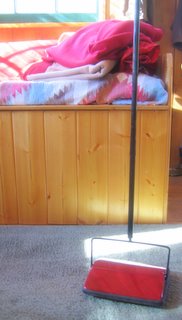
cabin-302-4.jpgI used a pan of hot water (no soap) and a scrub brush and the rug looks a lot better. Last year I tried cleaning my rug in the snow as told to me in this Mother Earth News article but it wasn’t a complete sucess and dragging my dirty rug out into the brilliant snow and sunshine made it look that much more dingier.

Light

Wednesday, November 15th, 2006

cabin-229.jpg One of the joys of living with out electric lights is just laying back and enjoying the world getting darker and lighter. Lights are nice to  have if I want to read a book or cook somthing but it’s not mandatory that everytime it starts to get dark I have to have light.

Though I have a small solar system, the only thing it runs is my laptop. For light I use a L.E.D. headlamp. With it I can read, cook, clean up, bring in wood, ect. This one has a really super bright spot light for when you need a lot of light and three not so bright L.E.D.s for other times. It takes 3 AAA batteries. I also bought this one at Wal-mart for 13 dollars that has 2 white LED’s and one red one; you can switch between the white and red. I wanted a red one so that I could look at a star chart without losing my night vision. I’ve been happy with that headlamp as well and it’s nice to have in case of company or when I need to change my batteries in my other headlamp.

I just got this battery charger so that I don’t have to buy so many batteries. It is dual voltage for international travel and comes with an ac cord, a dc cord and a USB cord so that you can recharge your batteries through your computer. It says that it will charge 4 AAA’s in 22 minutes.cabin-119.jpg

If I have company or I just want some nice light to hang out with, I use oil lamps or tealights. I use Ultra-pure lamp oil in my lamps; anything else will stink up my cabin. It’s expensive, Wal-mart sells it for 4.49 for 64 ounces which is much cheaper than anywhere else.

Library for a nomadic wilderness dweller.

Tuesday, November 14th, 2006

cabin-218.jpgIt would be impossibly expensive and take up too much room in my cabin to buy enough books to last me through even one winter. So rather than sit with my own thoughts, last year I bought a laptop, and a solar panel to power it, and headed to my cabin to be snowed in. I didn’t have a phone then, so I couldn’t connect to the internet, but I stayed happy reading the folowing.: Project Gutenberg DVD This is a free dvd with 9600 books on it, whose copyrights have expired. Most of the books are at least 80 years old but as long as you have power for your laptop you will always have something good to read. You can download it or they will mail it to you. There is also a CD version but with only 600 books on it. Project Gutenberg has 19,000 books at their web page that you can download for free.

Encarta Encylopedia Premiumencarta.jpg

I have the 2005 deluxe edition: a huge stand alone computer encyclopedia, atlas, and dictionary. Most of the authors that I would read in Project Gutenberg also had entries and often literary guides in Encarta. A search box can be docked on your task bar for handy looking up of words or subjects. I found it really nice to be reading a Project Gutenberg book and coming to a word I didn’t know, copying it and pasting it in the dictionary search bar and getting a definition with the option of also hearing it spoken. Often when I’m reading a paper book and I come to some reference, word or place that I’m not familiar with I just keep reading but with this handy encyclopedia, atlas, and dictionary it’s so easy to look things up.

This encyclopedia also has articles from magazines like, National Geographic and Scientific America. In addition to all this it has an extensive history of African Americans; the slave narratives alone will keep you in good reads for weeks.

men.jpgAnd for any pragmatic advice on cabin living, I would turn to:Thirty years of Mother Earth News articles on CD

Backpacking stove

Sunday, November 12th, 2006

collage2-1.jpgA stove is nice to have. Life is just better when you have a hot beverage to drink. A hot meal is not necessary but psychologically a hot meal can be both soothing and uplifting. And life is all about where your mind is.

The backpacking stove I now use is the Brunton CRUX Compact Foldable Canister Stove, it weighs 3.1 ounces. The reason I bought this one is it’s higher than average BTU output.

It’s a canister stove.  I like canister stoves because I can use them anywhere, from on the trail to a vehicle to a hotel room and they heat water fast. They also pose less of a fire hazard than other backpacking stoves. I have found the canisters in Thailand and in most places in the US. Worldwide they probably are available but you might have to spend a day finding them once you arrive.

You can’t bring the canisters on the plane but you can mail them to yourself, domestically, by writing on the box: “Surface Mail Only, Consumer commodity, ORM-D.”

One medium 8 oz (12oz total weight) canister will usually last me 10 days for all my meals and hot beverage needs. When traveling and using it just for a cup or two of coffee in the morning and the occasionally pot of ramen, 2- 8 oz canisters lasted me more than 3 months. The small 4 ounce canisters barely last 3 days.

The canisters are recyclable, though you may have to puncture them first. The biggest draw back on the canister stove is the price of the canisters, ranging anywhere from 3.00 to 6.50 apiece; acceptable when I’m traveling but pricy for cabin use. Sometimes discount stores like Wal-Mart and Fred Meyer have an off brand of fuel for much less then the outdoor stores and works just as well.

All I ever do is boil water on it: I add food and water, heat to boiling or almost boiling, turn off the stove and let the food sit in the pot with the foil lid on it and finish cooking without the stove going.

There are lots of lightweight stove options ranging from wood to gas, some you make yourself, at http://zenstoves.net/

If you get a canister stove that comes with a peizo igniter, remove it, it weighs more than a small Bic lighter and is less useful and less dependable. Also, carry a spare Bic lighter. I also threw out the case that the stove came with. It’s just unnecessary weight. The canisters fit in my pot for storage all though with some of them I have to turn them upside down to make them fit. I store the stove, can opener and lighter in a light plastic sandwich bag before storing them in the bottom of the pot, so they don’t get wet, and then put the fuel canister in the pot and keep everything in a 8” x 9” nylon ditty bag.

Yoga class for recluses

Saturday, November 11th, 2006

cabin-133.jpgI first heard about Richard Hittleman’s Yoga: 28 Day Exercise Plan from Ray Jardine in Beyond Backpacking. He said that it was one of the things he did to prepare for a long hike. It’s not just a twenty eight day course, it’s a life long yoga program that will make you strong, flexable and healthy. The book is horribly dated; it’s from the seventies, but I can overlook that.

Cabin stove.

Friday, November 10th, 2006

cabin-126.jpg

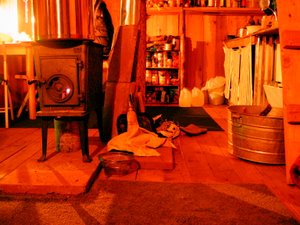
This is my stove. I bought it online at Cabellas along with a 12′ propane hose and regulator. I drilled a hole in the floor using a 1″ spade Bit and a cordless drill; the 1″ bit was to big but it was the smallest size spade bit I had. Since there is very little clearance under that side of the cabin, barley enough to get my hand in, I tied a thin rope off inside and dropped the other end down the hole. Then I reached under and grabbed the rope and tied it to the inside end of the hose. Then I went inside and pulled it in. I stuffed foil around the gap around the hole and the hose.

I have it hooked up to a 30 lb propane tank outside. I think this will last me all winter, but I have lots of spares if it doesn’t. The stove simmers well, yet it also has a high 15,000 BTU output.

Update: It’s March 27th and the stove has worked well all winter. I’m still on the same 30 gallon propane thank that I originally hooked it up to.

Update: On October 30th, almost a year after I hooked it up, my 30lb propane tank finally ran out.

My cabin’s water system.

Sunday, November 5th, 2006

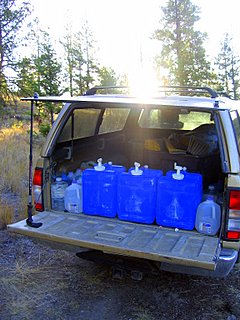
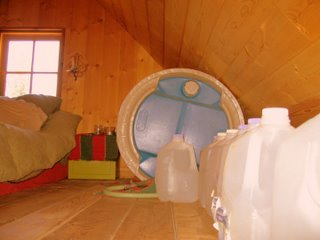
cabin water systemI don’t have a well so I fetch my water in a bunch of one gallon bottles. There is a spring about ¼ mile away but, in the summer I worry about the cows polluting it so I pay the town 10 dollars for 500 gallons and fill up at the community spigot. In the winter, I put 4 jugs in my backpack when I head out for my walk, and fill them up at the spring. I also have a 55 gallon drum in my loft that feeds to the sink below it. I fill it up using a funnel and the one gallon jugs. Mostly, I just use the water straight out of the jugs and save the water in the barrel for when I need running water, like to rinse my dishes. This system combined with 8 gallons of hot water on my wood stove is a comfortable system.

I keep the empty bottles on a rope wrapped though their handles. That way I just have to grab the rope and sling all the empties into my pickup.
In the winter I leave a couple of the bottles outside to freeze then put them in my cooler to keep my fresh food cool.

Every day you should…

Saturday, November 4th, 2006

collage.jpg

When a nomad stops moving.

Friday, November 3rd, 2006

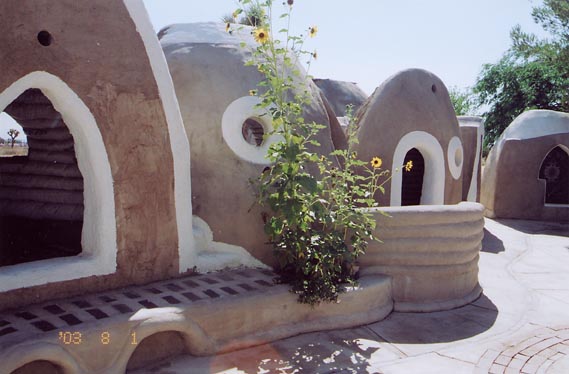
cabin-400-1.jpgSometimes when I’m sitting in my cabin, my mind turns to having a pet: a dog or a cat. I forget how much work and money a pet takes. I forget that a pet will tie me down. That I can forget about hiking or travel. And sometimes, when I’m snug in my cabin, I think why do I need to go anywhere? I could just stay here, build my cob house, plant a garden and have a pet. Sounds nice. But I know the need to roam will rear up in me after awhile and I will be antsy for adventure.

Ice shoes.

Friday, November 3rd, 2006

cabin-166-1.jpg


For taking long walks on ice and packed snow, nothing works better for me then screwing sheet metal screws in to my shoes. I get the kind with the hex nut head, 3/8 inch long for the toe and 1/2 inch long for the back of the shoe. For complete instructions visit http://www.skyrunner.com/screwshoe.htm. I don’t have a hex nut attachment for my cordless drill so I used my screwdriver’s hex nut driver and did it by hand. The screw driver is called a 6 way all in one screwdriver.

Last year I went through 2 pairs of Yak-Traks: they broke after about 2 weeks of use. Then I tried a pair of light weight instep crampons but they were always slipping up and I had to stop and adjust them all the time. Then I learned about the screw shoe. When spring came I just took out the screws and my running shoes where fine.

NOTE: Change into screw less shoes before walking on nice floors.

My hot water system.

Monday, October 30th, 2006

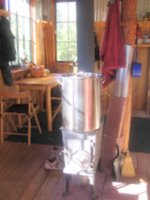
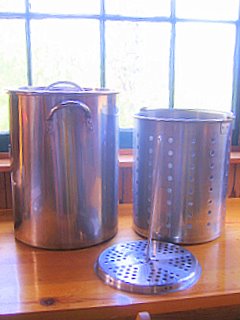
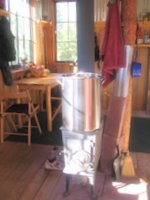
Cabin's hot water systemMy winter hot water system is the pot from the 8 gallon turkey fryer that I bought at Costco, for 99.00 dollars. It comes with a large colander. When there is snow I fill the colander with snow and drop it in to the partially filled pot and it instantly melts. It also stores heat from the stove. Whenever I need hot water, I dip it out with a small pan hanging nearby. The only drawback is it takes up most of the room on my stove. There is just enough room left to squeeze my backpacking pot in.

During the summer I use the propane burner that it comes with to heat my water.


My favorite wood splitting tool- the twisty wedge

Wednesday, October 25th, 2006

cabin-111-1.jpg

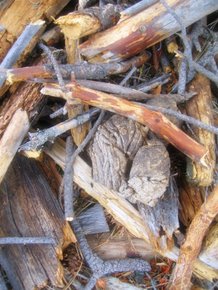
With this wedge I can split any piece of wood, no matter how knotty or green, and it never gets stuck. I just put it on the log, hit it with a sledge hammer a few times, and the log splits. The only place I’ve been able to find it is at Harbor Freight.

A Vagabond’s guide to kitchenware and dishwashing.

Tuesday, October 24th, 2006

cabin-092.jpg

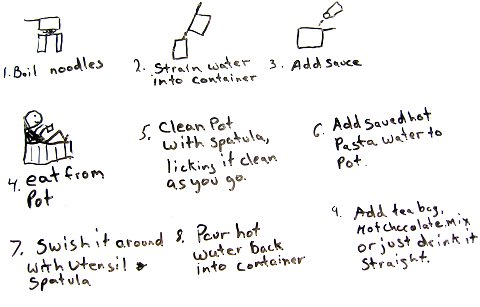
Whether you are on the road, trail or home this is a simple system for cooking and cleaning that will save you time and water:

Cook dinner in pot
Eat heartily, out of the pot, with big spoon.
Lick spoon clean
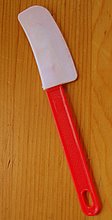
Scrape out pot with spatula. Licking off the spatula as you go.
Fill pot with water
Heat
Pour hot water into Nalgene bottle and add instant coffee, hot chocolate, or tea.
Drink up.

Now your pot is clean and you didn’t have to waste any water or time to clean it.
I have gone 6 months without ever washing my pot. . Total mess kit weighs 6.80 ounces (193 grams)

Pot I have the MSR Titan Kettle. It weighs 3 oz (85 grams) without the lid. This pot cost a lot. You can find a small aluminum pot in discount stores that will be just as light for 3-4 dollars. Don’t look for the pot in the pot section, look for it in the section that has cheese graters and lemon juicers. I found a pot there that holds a liter of water, weighs 3.5 ounces and has a handle. It was called a chocolate melting pot, I think. For more pot options see this helpful page on pots: Zen Stoves- pot page.

Foil lid- Weighs .10 (2 grams) Makes a lighter weight lid then the one the pot came with. It can also be used as a pot holder to grab the hot handles with. Also handy to have if you need to funnel a seep into your water bottle. A piece of foil probably has hundreds of uses.

Spoon. My favorite spoon was a metal Chinese spoon that I got in Thailand, but it disappeared and I can’t find another in the US. Right now I’m using a polycarbonate spoon, it weighs .35 ounce(9 grams), but I’m thinking of trying this nifty spork.

Bottle. The 16 oz nalgene wide mouth loop-top -polyethylene water bottle weighs 2.5 ounces (70 grams). The Nalgene bottle of course is also useful for carrying water, dipping cup for shallow water sources, a teapot, and a hot water bottle. I have kept warm on many cold nights with a nalgene bottle filled with hot water in my sleeping bag. It has never leaked. Eventually the Nalgene bottle gets pretty stained and sort of gross looking. Just fill with water and a little bleach and let it soak for a bit, add the spoon while you are at it. It will be clean in no time. The hard clear Nalgene lexan bottle doesn’t seem to stain, as badly, but it weighs an ounce more.

Spatula head. I find the smallest most flexible spatula I can, and take just the head off of it.

P-38 can opener. Weighs .30 ounces (9 grams) Tie a piece of flagging tape through the hole so that it is not so easily lost. Wikipedia has a list of 38 other things that you could do with it.

Knife- weighs .75 ounce (21 grams) I pack the Swiss Army Classic Pocket Knife. Again, tie a piece of flagging tape through the eye so you don’t lose it. Besides a knife it also sports a pair of scissors- that are strong enough to cut my toe nails, a tweezers, tooth pick, file and screwdriver.

Mess kit:

Pot 3 oz (85 grams)

spoon .35 oz (9 grams)

piece of foil for lid .10 (2 grams)

Spatula head .25 (6 grams)

Nalgene 16 oz bottle 2.5 oz (71 grams)

Knife .75 (21 grams)

Total weight: 6.80 oz (192 grams)