I like going to the library. If I will be in a town for more than a month; I call myself a resident and get a card. At one time in my life I had books checked out from 5 different library systems.
The worse library system that I have ever encountered is the Multnomah County Library. Those surly librarians were always annoyed with me for some reason. When I was a kid, the children’s librarian was always scolding me for not being carful enough when using the big dictionary. She would run over and say, “We have to be very careful with this; it is very fragile.â€? Why would anyone buy a fragile dictionary to begin with and then to add stupidity on top of impracticability, put it in the children’s library?
As I got older I ventured out of the children’s library. When I brought my books to the check out they would say” these are adult books you need to get permission to check them out. Go to the big desk.” Most of my life, checking out books at the downtown library required going, for one reason or another, to that big desk. As I remember it was this large room with soaring ceilings and a very high counter like a judge’s pulpit and there I would have to plead my case as to why they should let me check out books. Sometimes they wouldn’t let me. Most of the times I was sent there was because of overdue library fines.
The exorbitant library fines were hard when it was just me; a good chunk of my babysitting money would go to the library, but when I had a child they became crushing. It doesn’t take very long to read a children’s book so we would have to get quite a few children’s book at a time to keep us in reading material very long. Since life gets busy when you are a single parent working 60 hours a week sometimes the books wouldn’t get returned on time. Often the fines exceeded the price of the item I had checked out. At one point I just started buying books instead of going to the library, saying, “It’s justs cheaper, this way.”
We moved away from the Multnomah county library and started going to the Forest Grove library where they didn’t have fines and the librarian is happy that you came in to get some books.
My son came up with this theory about librarians: There are two kinds of librarians: (1) those that see themselves as keepers of knowledge and(2) those that think of themselves as educators of the community.
The keepers of knowledge don’t want you to check out any books they just want to have them all there still in the same condition as when they bought them… Those librarians are never happy when you come in to take “theirâ€? books and I think if they could, would like all the books under glass and locked up.
Then there are the librarians that see themselves as educators of the community and those librarians see books as tools that need to be used to be of any use. They are happy when you come in and happy to see you leave with a bunch of books.
We eventually moved back to Portland, right away the fines started piling up. (Now the library had videos and the late fee for a video was a dollar a day!) But we always paid them before they would let us check out more books. But then the Multnomah County Library started giving their accounts to a collection agency. This is not for unreturned library books this is for books that were returned late. My son moved away to Florida and went to buy a house. When he applied for a loan, his credit report had a ding on it from the Multnomah County Library. Even the loan officer was surprised to find that someone’s credit rating had been hurt from overdue library fines.
I have since moved away, myself. Yet once when driving through town I stopped to use the Internet, as I have done in dozens of libraries across the country. The librarian said the internet is only for people with a Multnomah County library card. Since library cards don’t expire, I said I have one but I don’t have it with me. She looked me up in the computer, turned to me and with a look and a voice most often found on police officers and Nazis said, “You know, you have 97 dollars in fines”.
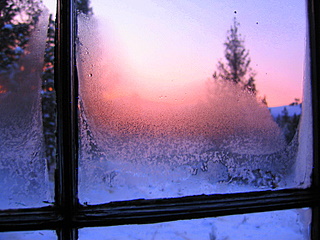 It got down to -12 F(-24) yesterday and a strange haze covered the entire sky and blocked out the sun. I had to bring the generator inside to let it warm up before I could start it. It was 11 degrees F this morning ; I think things will start warming up.
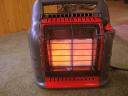 not knowing how cold it would get or how I would react to the cold I bought a portable propane heater and a 12ft hose, so I could hook it up to a 20lb propane canister. I never used it because it seemed kind of whimpy to not deal with the cold. This year I hooked it up and use it to help the wood stove heat up the cabin. It has been very nice to wake up in a cold cabin, turn on the propane heater and then start the fire. In a very short time my cabin is cozy again.
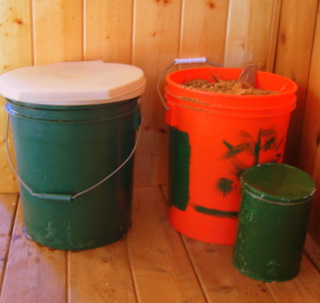 This is my composting toilet. I use it, throw the paper in it, and cover with sawdust. When it is full, I dump in under a big pine tree and rake pine needles over it. Next, I rinse out the bucket with my saved gray water and throw the water on the pile. There isn’t any smell.
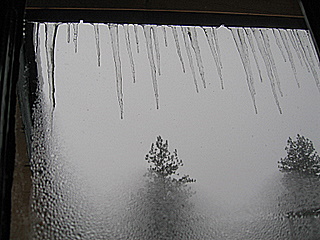 A lot of snow fell yesterday. Today, I put on my snow shoes to go for my walk. It was 8 degrees F (-13 C) when I went on my walk, now it’s 4 degrees (-15C) and I presume it will get colder tonight. I didn’t know it could snow when it got this cold but it’s still coming down.
 the same reasons. In an old Boy Scouts manual they also recommended wearing shoes that let your feet move as the key to keeping them warm in the snow. Boots hold your feet stiffly so your feet get a lot colder. My snow shoes are called
 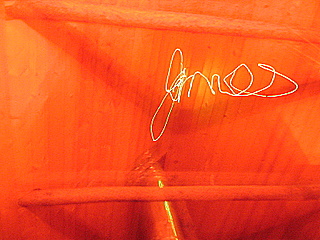 My son came for Thanksgiving weekend. He brought with him a small hand held powerful laser. Outside we looked at the stars and pointed at them with the laser. Inside he wrote his name with the laser while I took a picture using a 10 second shutter speed.
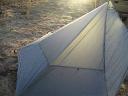 light weight floor option. You can use a trekking pole with it or buy the optional 1.8 oz ( 51grams) pole. It sets up fast, and offers a lot of room- enough for 2 in an emergency. Things I look for in a tent: covered porch so I can lay in my bag and cook dinner out of the rain, fast set up, full bug protection, and light weight. This tent offers all of these things. Mesh comes up the sides so that even though it is a single wall tent , places where you
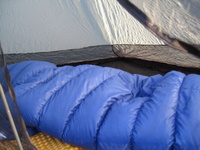 might touch the walls are double wall. It comes in gray and green. Grey is the best color, I think, for not being seen.
 have huge cockroaches or rats in them and I can’t sleep when surrounded by huge cockroaches and rats. Cockroaches and rats don’t hurt you but ticks, lice, mosquitoes, and spiders can kill you. This travel tent is free standing and fits on a single sized bed. It has a breathable nylon floor that extends up the sides so nothing can bite you where you might touch the sides. I can stay anywhere with this tent, just zip myself up and rest easy. It weighs 1.9 lbs (.86 kg)

 , if you like.